
Air quality benefits of prescribed fire
by: Marshall
Iván Higuera-Mendieta and I have a new paper out in Science today [ungated link that might not last] that tries to understand the air quality impacts of prescribed burning. Specifically, we try to estimate the potential impacts of a (still hypothetical) dramatically expanded use of prescribed burning in California. California has for years proposed such an effort, with an announced target in 2022 of up to a million acres treated by 2025 … which we’ve now clearly passed, and missed, having burned perhaps 100-200k acres/year over the last few years, which was already substantially more than in most previous years. Similar targets are being set elsewhere in the US, with the US Forest Service targeting 2-5million acres/year, and the repeatedly introduced-but-not-passed National Prescribed Fire Act requiring the USFS and Bureau of Land Management to increase prescribed fire acreage by 10% a year for 10 years. California also has a longer-term target, its Nature-Based Solutions Targets (required by AB 1757), which set a goal of treating 800k acres with beneficial fire by 2030 and 1.5 million acres by 2045.
Our goal was to try to understand what meeting these targets would mean for air quality in the State. Smoke from wildfires is one of, if not the, most rapidly growing environmental threat to public health in the US. In earlier work we estimate that such smoke is rapidly undoing decades of progress in improving air quality, and that under a business as usual scenario, climate-driven increases in future wildfire smoke would represent the single largest climate impact in the US by a large margin.
But, purposely lighting stuff on fire generates smoke. And lighting a lot of it on fire could generate a lot of smoke. But there was no estimate of the actual tradeoff: expanded low-severity prescribed fire gives you initial smoke with certainty, with the hope of substantially reduced smoke in the future. Overall, do you get more or less total smoke? Knowing the answer is critical for evaluating the public health impacts of prescribed fire, which is itself critical given the centrality of prescribed fire in CA’s wildfire and climate resilience strategies.
Step 1: how much does prescribed fire reduce future fire severity?
The first step was to understand the impact of prescribed fire on future wildfire severity. Here we were on reasonably strong ground, given strong evidence from a number of local and regional settings showing that previous low severity or prescribed fire reduced future fire risk (e.g. here, here, here, here, and here). As in much of this past work, a key chicken-and-egg problem was the relative paucity of historical prescribed fire activity. To overcome this data challenge, we used observed low severity wildfire as a proxy for prescribed fire, a choice supported by this earlier work that allowed us a much larger sample of observed fires to work with.
We (read: Iván) compiled multiple decades of satellite-based measures of fire severity at the level of a 30-meter pixel. With these data we could observe pixels that burned at various severities and follow them over time to see if and when they burned again and at what severity. We could then ask two questions: (1) when looking across decades of wildfires in California, what was the effect of low severity fire on subsequent fire risk and severity? and (2) if one pixel is “treated” with low severity fire, do the benefits in terms of reduced future fire risk spill over to nearby untreated pixels? Local level evidence suggested these spillover or “shadow” effects could be important, but they had not been documented at large scale.
To estimate these impacts, we used an approach called synthetic control, where for each pixel “treated” with low-severity fire, we found a set of pixels that looked similar on a range of other characteristics (fire history, slope, elevation, vegetation type, etc) but which had not been exposed recently to fire. We could then follow treated and matched “control” pixels over time, including the potential “spillover” beneficiary pixels around the treated pixel, and compare what happened to subsequent fire activity and severity.
Results are shown in the figure below, where treatment effects are expressed as relative risk, which here is the subsequent risk of severe fire in treated pixels as compared to matched controls; a RR=1 means no difference, and an RR of 0.5 means risk was 50% lower in treated pixels. We see that in pixels exposed to low severity fire, the subsequent risk of severe wildfire in that pixels fell by nearly 90% in the following few years, and remained below 50% for at least a decade before returning to baseline levels at about year 13. Importantly, for at least 2 kilometers from the treated pixel, we see meaningful and sustained reductions in risk as well, suggesting large spillover benefits to nearby untreated pixels.
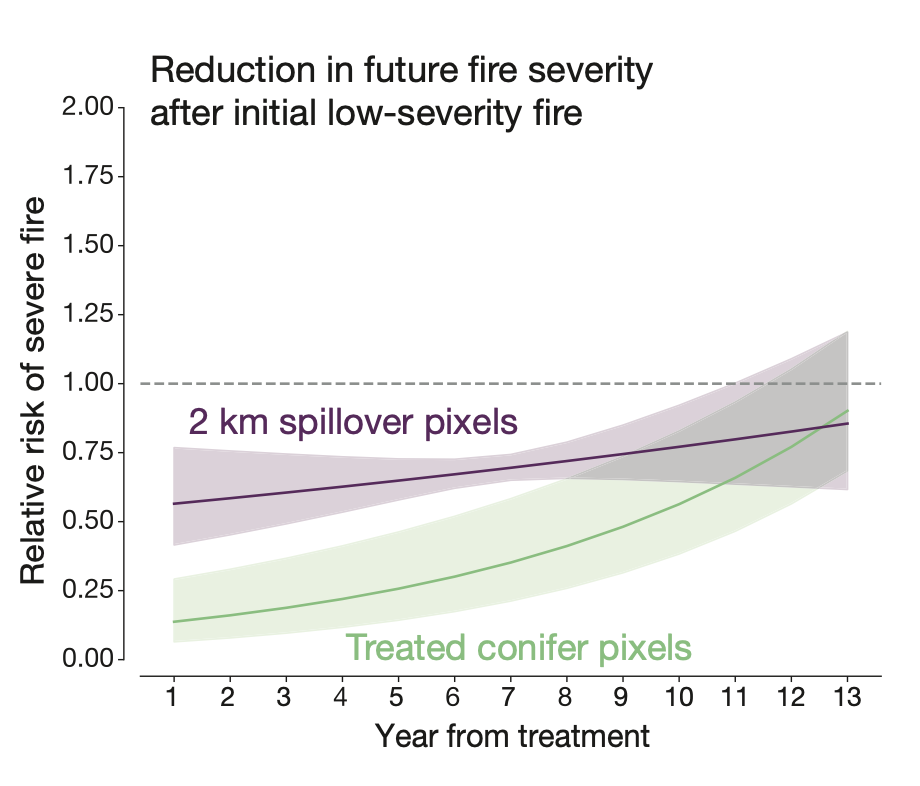
Effect of low severity fire in conifer forests on subsequent fire activity and severity. Green: effects on “treated” pixels. Purple: effects on nearby untreated “spillover” pixels.
Critically, these effects show up strongly in CA conifer forests (think Sierras, Coast Ranges) but are not as evident in chaparral or shrubland systems (think much of central and southern CA), consistent with a range of other evidence (eg here). Unlike in conifer forests, where prior to suppression frequent low-severity fire was common, fire return intervals were much longer in chaparral systems and low severity fire was rare. We find that low severity fire perhaps reduces the likelihood of any fire for a few years, but has no clear impact on high severity fire - see figure below. This supports the notion that the 2025 fires in LA would likely not have been substantially affected by a prior prescribed burning effort in the area.
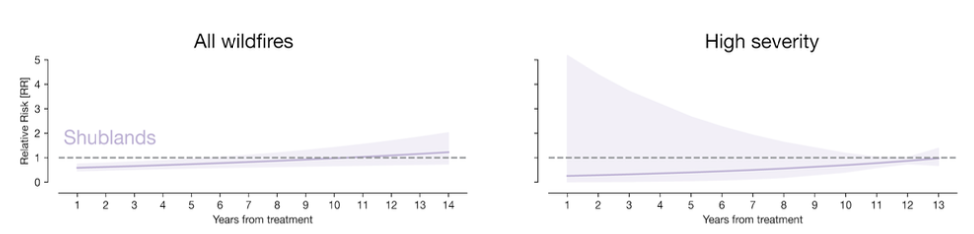
Effect of low severity fire in chaparral/shrublands on subsequent fire activity and severity.
Step 2: understanding smoke impacts
What might these sustained reductions in risk of extreme fire mean for total smoke exposure? The key tradeoff is again that any initial burning incurs smoke emissions with certainty, for an uncertain future reduction in smoke. And to actually reap this future benefit, your treated pixel has to experience a future wildfire — and the chance of any particular pixel burning in any year is very small.
To understand this tradeoff, we built on earlier work in our lab led by Marissa Childs that used satellites and ground monitors to measure wildfire smoke particulate matter across the US at daily scale [updated smoke data here], and subsequent work led by Jeff Wen that used a particle transport model to trace out what of this smoke came from what wildfire. These data allow us to estimate how changes in fire severity, holding fire size fixed, affect downwind smoke exposure.
We can then run a bunch of counterfactuals where we ask: what if California had actually met its burning targets starting a decade ago? What would be the net effect on smoke? Specifically, we estimate what would have happened had CA burned up to a million acres/year starting in 2010. We assume that treatments are applied randomly to conifer forest pixels in CA (more on that below).
The first effect of such a policy is to substantially alter the number of pixels burning at different severity. Specifically, you get way more pixels burning at low severity (this is on purpose), but then eventually you also get more pixels that do not burn and meaningful reductions in the number of pixels burning at high or very high severity — and these are the pixels that generate by far the most smoke. In the most recent extreme wildfire years (2020/2021), we see reductions in extreme wildfire of about 25% under this policy.
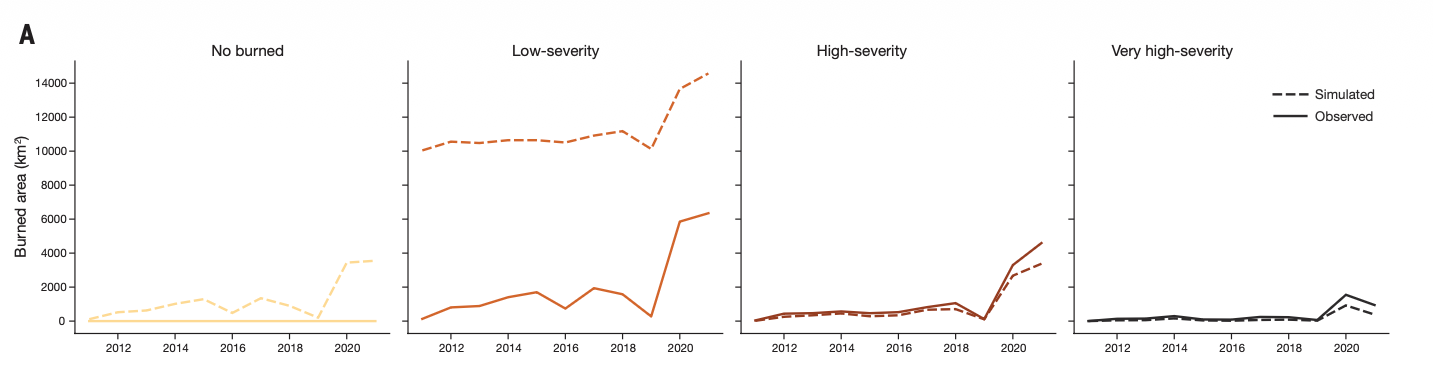
Changes in the amount of area burned under different severity, based on a program of treating 1M acres/year starting in 2010. Solid line: historical observed activity. Dotted lines: counterfactual estimate under 1M acres/year treatment regime.
What happens to smoke? Initially, and especially in the low fire (and thus low smoke) years in the early 2010s, you get a lot more smoke under an aggressive prescribed burning than you would have had otherwise: you are simply burning way more acreage than would have burned otherwise, even though nearly all of it is at low severity. As observed wildfire activity ramps up through the 2010s, you see the benefits of prescribed burning start to accumulate, and under most treatment regimes you get net benefits (i.e. cumulative smoke reductions) within about 5 years. By 2020 and 2021, historically the worst smoke years on record in CA, you get annual reductions of 20-25% in smoke under the most aggressive treatment plans (500k acres/yr), and cumulative benefits over the decade are about 10%.
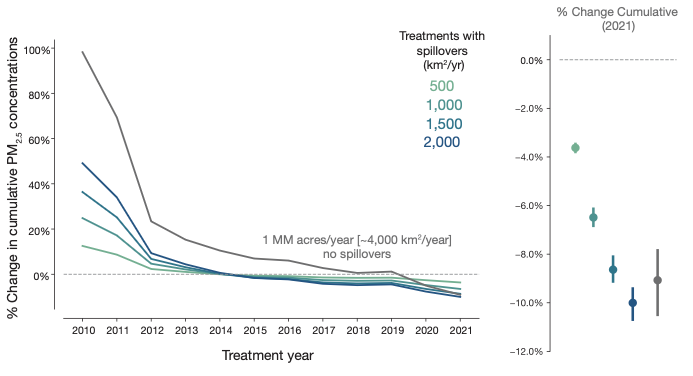
The impacts of a decade of prescribed fire treatments on cumulative smoke exposure. Different lines show different levels of annual treatments, up to 2000 sq km year (~ 500k acres/year).
Are these numbers large or small? Part of the challenge in our exercise is that we start our expanded prescribed burning policy in years in which wildfire activity is low. In these years, you generate more smoke than you save, and benefits only arrive much later in more extreme wildfire years. This also means that later treatments had much higher individual returns: an acre treated in 2019 was very likely to encounter a wildfire in 2020 (when a large percentage of CA forest was on fire), meaning the benefits would have been immediate and large.
Another way to understand these differences is to instead calculate the average per-acre benefits you would get if you for an acre burned at any time between 2010 and 2020. A 2010 treated acre would not see benefits for years, whereas a 2019 treated acre could see large benefits the next year. The average over initial treatment years is then the average expected benefit of treating one acre. Here we see much larger benefits: including spillovers to nearby untreated pixels, and discounting benefits back to the treatment year, we see smoke benefits exceeding costs by a factor of 5. This is big! This tells us that any treated acre on average provides large expected returns in terms of reduced smoke. Combined with the previous results, it also tells us that we have to treat a bunch of acres to make a meaningful dent in total smoke exposure, given the large amount of wildfire the state experiences. Each treated acre brings benefits, but we need lots of acres to bring meaningful state-wide reductions in smoke exposure.
Things to improve, other recent lit, other items
Our simulations assume that treatments are applied randomly to conifer forests. What if could instead target them to areas most likely to burn in wildfires? In our simulations this would substantially improve benefits relative to costs. But, it turns out it is extremely hard to predict where and when large fires are going to happen — at regional scale, fire activity is closely linked to fuel aridity and other weather variables, but at local scale, the needed spark happens pretty randomly. Looking at data on actual prescribed fires carried out in the state over the last decade, we see that targeting was only slightly better than random for most years (see Fig S20 in the paper). This doesn’t mean this can’t be improved, but it means that even with more selective historical treatments we were not able to do a lot better than random.
Things our paper does not do:
We do not look directly at health benefits. For health impacts that are roughly linearly related to smoke — which in our previous work includes things like asthma ED visits — our smoke reductions can be directly translated to health benefits. For health impacts with a slightly more complex relationship with smoke — which in our previous works, includes things like all-cause mortality — there are likely benefits but their shape is less obvious. This is an area for future work.
We do not look directly at the benefits for structure loss, ecosystems, carbon emissions, or other negative impacts of wildfire. These are likely quite important. However, our results again caution that these benefits would not clearly be present for recent, incredibly damaging fires in chaparral ecosystems (e.g the 2025 LA fires).
A recent closely related paper published by Strabo and colleagues in Science uses data on the more limited number of actual prescribed fires and measures their limiting effect on fire spread. Their results are highly consistent with ours qualitatively, and even quantitatively they find monetized benefit/cost ratios of 3-4, which is surprisingly close to our smoke-based B/C estimate of 5, even though they are using a very different approach and data. I will leave the details of the differences between our study and theirs to another post, but overall our combined studies suggest large average benefits to prescribed fire treatments, even if these benefits take some years to arrive.
My broader worry for both of our papers is perhaps twofold: (1) we as a society are not all that good at delayed gratification, especially if we have to pay a cost up front, and (2) damages that occur are always easier to observe than damages that didn’t occur. We will always have damaging wildfire no matter how much prescribed burning we do. My hope is that our papers can help folks see that the benefits of prescribed fire, even if hard to see directly, can be pretty large, and that we should probably be doing lots more of it.