
Declining gender gaps in ultra-running?
By: Marshall
[Editor’s note: we depart from our typical environmental content to do some nerd-ing on recent data ultra-running performances. See past related content on the effect of temperature on ultra-running performance.]
A few weeks ago, Rachel Entrekin won the 2026 Cocodona 250. Not the women's race — the whole race. She took the overall lead at mile ~60 and finished in just over 56 hours, breaking the previous overall course record by more than two hours. It wasn't the first outright win by a woman in a major ultra - Courtney Dauwalter was the overall winner of Moab 240 in 2017, and Claire Bannwarth ws the outright winner of the 2023 Tahoe 200, among a few other examples. But what made Rachel's performance particularly impressive was that it was against a relatively stacked men's field and Courtney -- who as reasonably claim to one of the all-time GOATs in ultraunning, man or woman -- was in the field as well, alongside many other really strong ladies.
The coverage that followed was appropriately glowing and, in many cases, framed Entrekin's win as evidence of a broader shift. A nice piece argued that women are increasingly competitive with men as races get longer, citing physiology — reduced muscle damage, more conservative pacing, more even effort over many hours. Other writers have argued similarly for some time.
I wanted to know whether Rachel's incredible performance was indeed part of a longer-term trend, in which women were gaining on men in ultras. As a currently injured ultra-runner with a Claude Max account, I was well-positioned to investigate.
So I scraped finishing-time data from ultrasignup.com (which hosts results for most major US trail ultras) and from utmb.world (which hosts results for UTMB Mont-Blanc and other UTMB World Series races in Europe), focusing on races 100K and longer that have published results for many years, ending up with 35 races covering 2005–2026 and roughly 190,000 starts (~150,000 finishes).
I treated 10 races as "tier 1" — the most competitive and widely watched ultras in the world: Western States 100, Hardrock 100, Javelina Jundred, Black Canyon Ultras, Lake Sonoma 50 (US) plus UTMB, CCC, Lavaredo Ultra Trail, Transgrancanaria Classic, and MIUT 115 (Europe). The remaining 25 races are "tier 2": Angeles Crest 100, Bigfoot 200, Bryce Canyon 100, Canyons 100K, Cascade Crest 100, Cocodona 250, Cruel Jewel 100, Georgia Death Race, High Lonesome 100, IMTUF 100, Kettle Moraine 100, Massanutten Mountain Trails 100, Moab 240, Mountain Lakes 100, Old Dominion 100, Pinhoti 100, Quicksilver, Run Rabbit Run, San Diego 100, Sean O'Brien 100K, Superior Fall Trail Race, Tahoe 200, The Bear 100, Tunnel Hill 100, and Wasatch Front 100. (A few major US races like Leadville, Vermont 100, HURT 100, and Bandera 100K publish results on their own sites and aren't included.)
For each race-year, I computed the gap between the fastest woman and the fastest man (the "top-1 gap") and between the average of the top-3 women and the average of the top-3 men (the "top-3 gap"). I also tracked the number of women finishing among the overall top 10 and top 20, and the share of women among all finishers.
More women are running and finishing ultras
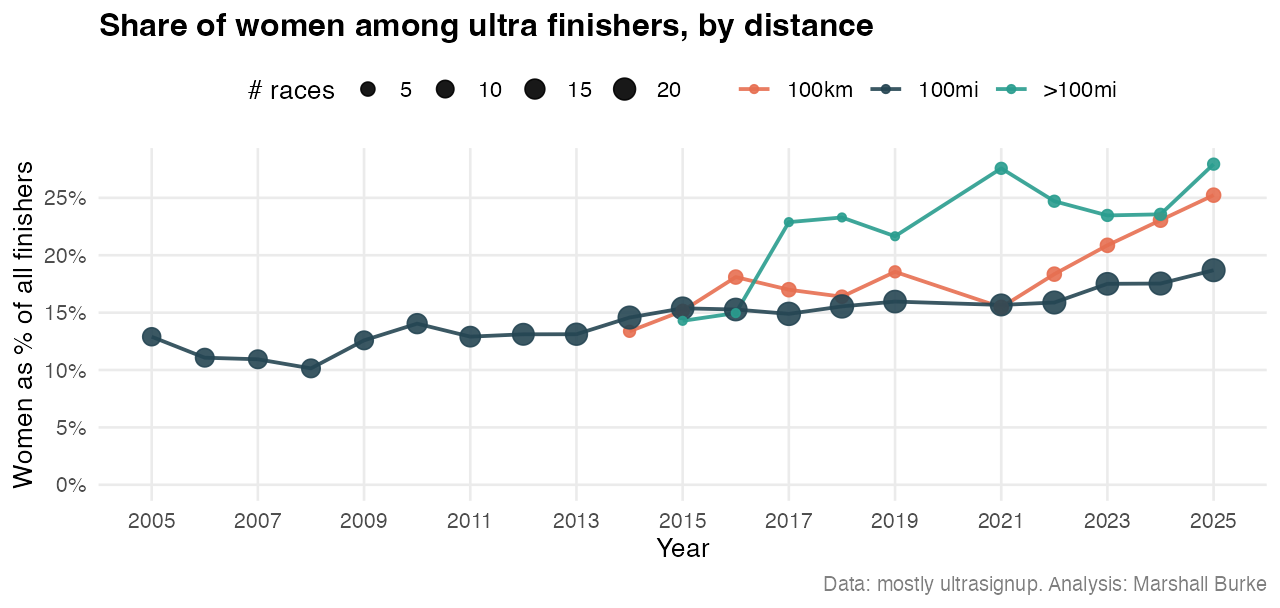
The share of women among ultra finishers has been steadily rising. In 2005 women were about 13% of finishers at the 100-mile races I looked at; by 2025 that share had roughly doubled. The same trend shows up at the shorter (100K) and longer (200+ mile) distances.
Are the top women getting closer to the top men?
Below are the year-by-year gaps between the fastest women and the fastest men, broken out by distance: 100km races, 100-mile races, and the longer 200- to 250-mile races. Each dot is one race-year; the colored line is a linear fit within each bucket. The panel headers show the estimated annual change in the gap (Δ, in percentage points per year), with a "*" denoting p < 0.05. The first plot is for averages of the top 3 male and female finishers, the second plot is for the gap between the winning male and female finisher.
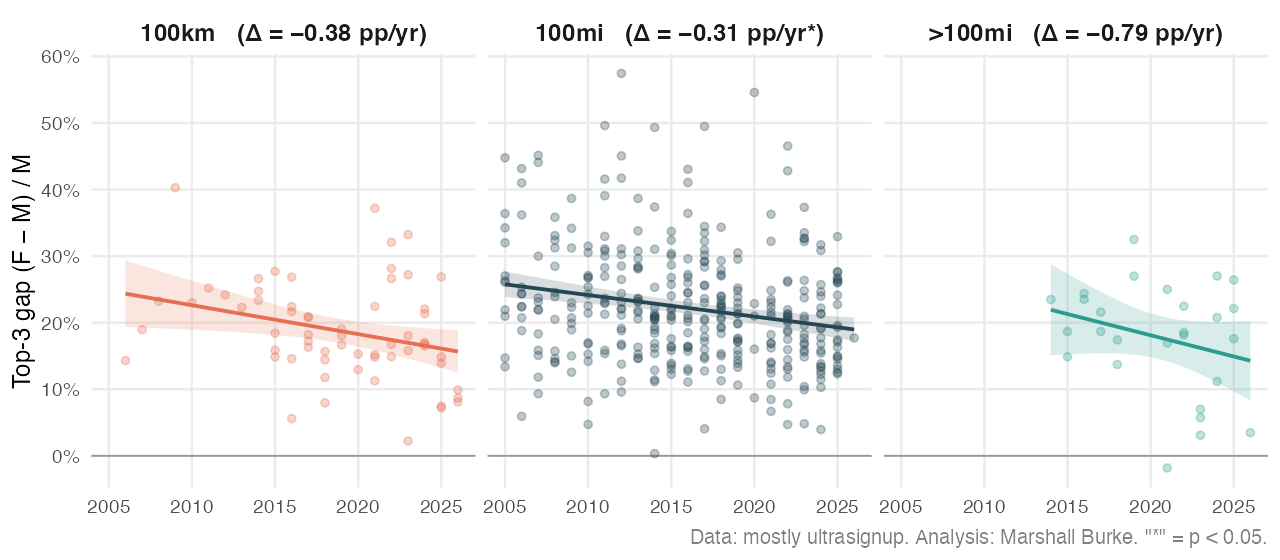
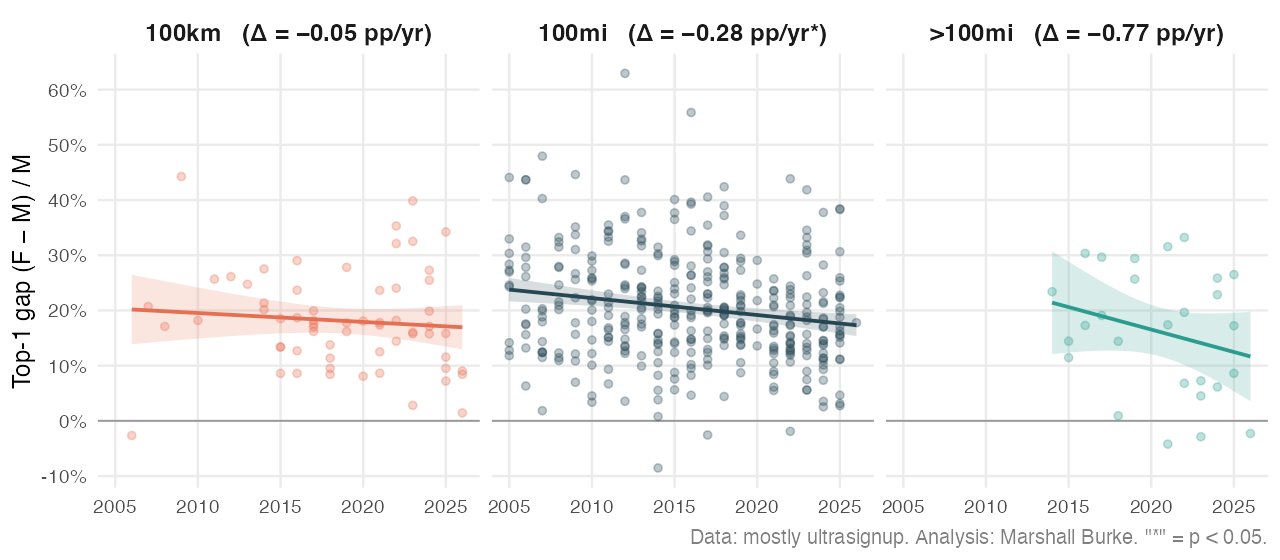
Both plots show a reasonably steady decline in the gap. The 100-mile bucket is the cleanest because it has the most race-years in our data: the top-3 gap shrinks by about 0.3 percentage points per year (p < 0.05), or roughly 3 percentage points per decade, with the top-1 gap doing essentially the same thing (−0.28 pp/yr). The 100km and >100mi buckets point the same direction; the >100mi point estimates are larger but the samples are smaller, so the error bars are wider. So: time gaps between top men and women seem to be coming down at distances from 100km to 100+ miles.
We can also ask: how often do women crack the overall top 10 (or top 20) at these races? This sidesteps the question of how to compare exact times across different courses and conditions. This number has also been similarly trending. Across all our races, the count of women in the overall top 20 at a given race has been increasing by about 1.5% per year (or from roughly 2 to 3 over the period). The top-10 trend is in the same direction but a bit noisier.
Is this progress fast or slow? Current trends in finishing time gaps would suggest gender gaps in finishing time would not be eliminated for many more decades. But, trends in top-10 and top-20 finishes would suggest that we should expect to see many more women mixing it up near the front of races in coming decades, maybe particularly at the longest distances where they are already performing well.
More women, faster women
How much of this effect is driven by women getting relatively faster, versus by more women -- and likely therefore, a higher chance of very fast women -- being in the field? Turns out it's at least partly the latter: if we add controls for the size of the men's and women's finishing fields to the regressions above, the year coefficients on the time-gap collapse to essentially zero. In other words, once you account for the fact that women's fields are growing, there is clear no additional within-race trend toward faster top women. So women's fields are getting faster in part because they are getting bigger.
The longer, the better?
A long-standing claim in ultrarunning is that women perform relatively better as distances grow — that the men's race-day advantage shrinks, and at some point may even flip. The piece linked at the top, "Built for the Long Haul," lays out a physiological argument: women appear to incur less muscle damage and systemic inflammation during very long efforts, and they tend to pace more conservatively than men, who are statistically more likely to blow up the back half. None of those mechanisms suggest women should run a flat 50K faster than men. They do suggest the field should look different once a race stretches past a day on its feet.
The plots above already hint at this, but the signal is most striking when you ignore times and just ask how often a woman has won a race outright. Across the entire database, there are 9 race-years (out of ~440 at 100km and up) where a woman finished first overall:
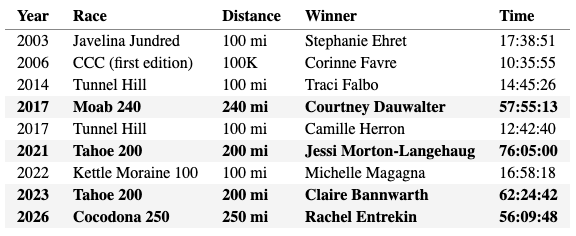
Four of the nine outright wins (highlighted) come at races of 200 miles or more. 200+ mile races make up only about 5% of our race-years (21 of ~430), but account for 44% of the outright women's wins. Put another way: a woman has won about 1 in 5 of all 200+ mile race-years in our dataset, vs. about 1 in 100 of all 100-mile race-years. Big gap!
So, Entrekin's historic Cocodona run is maybe the most iconic version of a pattern that has been forming in 200+ mile races for almost a decade, and is starting to emerge -- albeit a bit more slowly -- in gaps in finishing times at "shorter", 100km-100mi distances. Here's to hoping this continues, and that before long we'll no longer need the "Here for the women's race" shirts you see at races today, since there won’t be a meaningful difference in the men’s and women’s races.